Large Area Electrode Arrays on Cortex: Breakthrough Studies
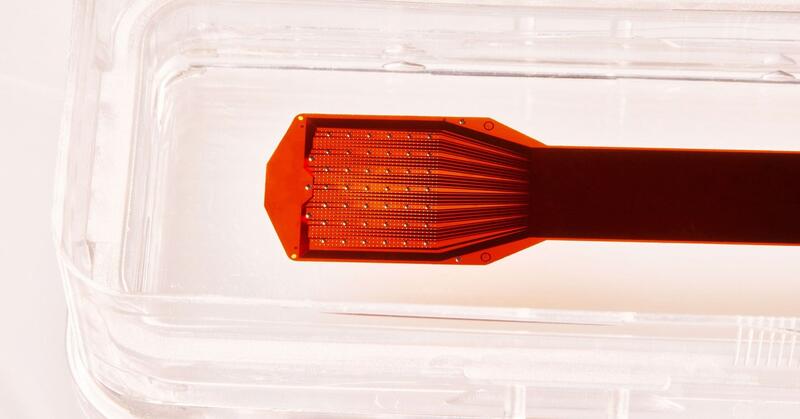
Image credit: Precision Neuroscience
While electrocorticography (ECoG) is a minimally invasive approach to map areas of the brain responsible for epilepsy (and guide surgery of lesions), it has its limitations – including the area of the cortex that is able to be mapped, spatial electrode resolution and other risks.
It is against this backdrop that new R&D (Science Robotics, Vol. 8, 2023) has focused on deploying large-area soft robotic electrode arrays on the cortex.
In a recent Swiss study, soft, microfabricated electrodes (and strain sensors) were placed within six legs of a tiny robotic system secured on the rim of a small craniotomy. The inventors of this system from the Swiss National Science Foundation and the Wyss Centre say, “soft robotic neurotechnology opens promising avenues for minimally invasive cortical surgery and applications related to neurological disorders such as motor and sensory deficits”.
The Swiss soft robotic system is one of a number of projects focused on improving the reach and effectiveness of ECoG.
Precision Neuroscience has taken a different path to capture brain signals over a large area of the cortex. Precision’s Layer 7 Cortical interface uses thin film technology to capture brain signals at micron scale, “providing an unprecedented view into the brain’s activity”.
Precision Neuroscience claims that “thousands of channels can be delivered anywhere on the brain’s surface using their patented, minimally invasive insertion method”. Each microelectrode array comprises 1024 electrodes ranging in diameter from 50 to 380 microns and is connected to a customised hardware interface. The array is said to offer 600 times greater electrode density than standard cortical arrays.
