AI-Powered Thought-to-Text Breakthrough Takes World Stage
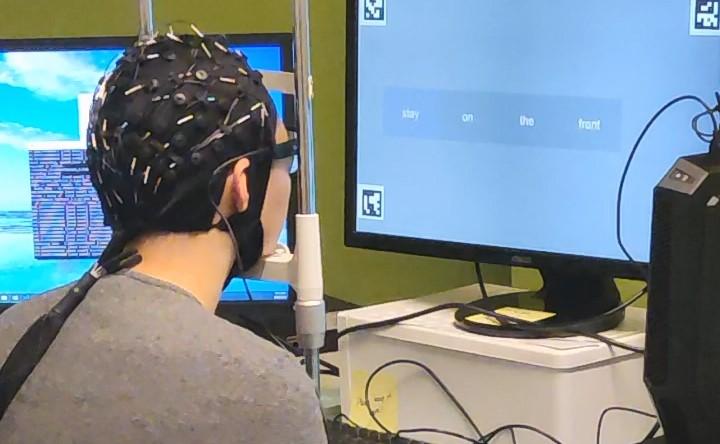
Image credit: University of Technology Sydney
Here’s another exciting Australian breakthrough in the world of medical bionics: a portable, non-invasive system that turns thoughts into text.
Developed by a team from the University of Technology Sydney (UTS), it is an exciting development for people unable to speak due to illness or injury, including stroke or paralysis.
Innovators said the world-first device could also enable seamless communication between humans and machines, such as the operation of a bionic arm or robot.
The study saw 29 participants wear a cap which recorded their brain activity via electroencephalogram (EEG), while silently reading provided text.
An artificial intelligence (AI)-powered model developed by the researchers then translated the EEG signals into words and sentences, based on machine learning of a significant amount of EEG data.
Conducted by a team from the GrapheneX-UTS Human-Centric Artificial Intelligence Centre, the study has been selected as a spotlight paper at the 2024 US-based NeurIPS conference for cutting-edge research on AI and machine learning.
“This research represents a pioneering effort in translating raw EEG waves directly into language, marking a significant breakthrough in the field,” said lead researcher, Distinguished Professor Chin-Teng Lin.
“It is the first to incorporate discrete encoding techniques in the brain-to-text translation process, introducing an innovative approach to neural decoding [and] the integration with large language models is also opening new frontiers in neuroscience and AI.”
Check out the technology in action in the video from UTS below:
For further information, see the full story via the UTS website.
