Bionic Hand Merges with Nervous and Skeletal Systems
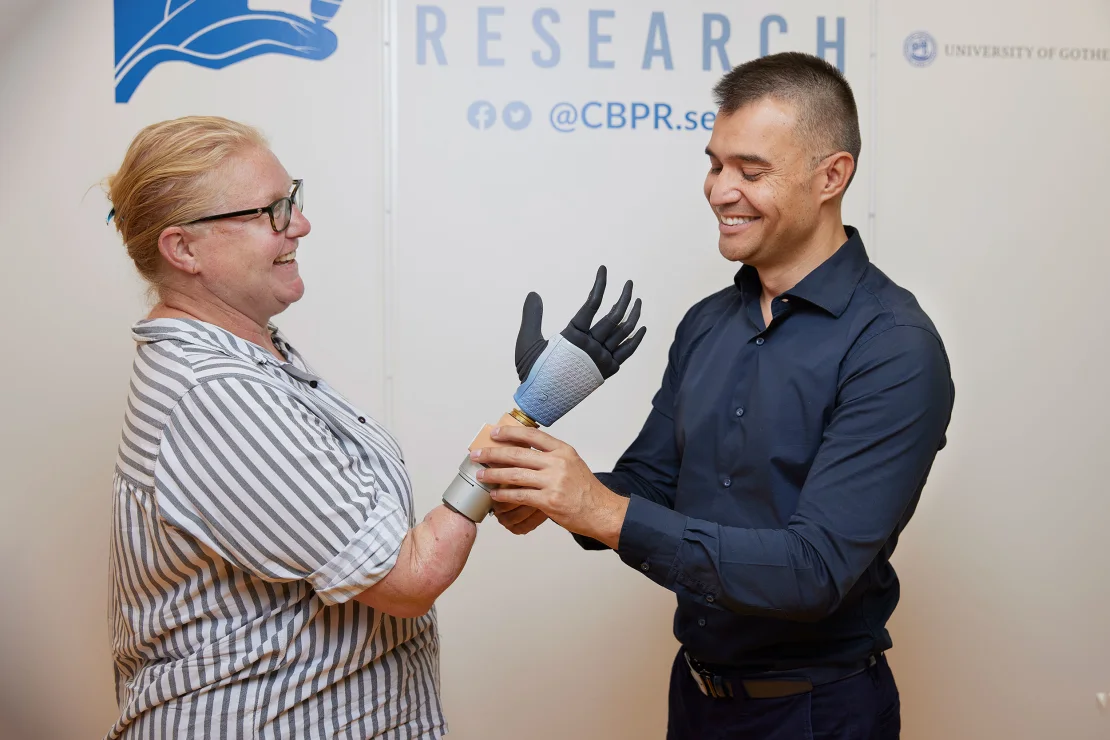
Image credit: Max Ortiz-Catalán
A new study has reported the integration of a bionic hand into a patient’s nervous and skeletal systems has worked successfully over a number of years, a first in someone with a below-elbow amputation.
Fifty-year-old Swedish woman, Karin lost her right hand in a farming accident, and in December 2018 received a novel human-machine interface implanted into her residual bone, nerves, and muscles.
Her residual limb was also surgically modified to support its integration with an artificial intelligence-powered bionic prosthetic hand, which feels some sensations and has helped her regain much of the daily activities lost while not being able to use both hands. Karin said it had also helped to significantly reduce the phantom pain she had been experiencing.
Professor Max Ortiz-Catalán, Head of Neural Prosthetic Research at Melbourne’s Bionics Institute and Founder of the Center for Bionics and Pain Research in Sweden, led the research. The findings were recently published in Science Robotics.
“It’s been a long journey,” Professor Ortiz-Catalán said in an interview last month with CNN.
“We’re still far away from Luke Skywalker’s hand… We’re still not close to all the functions of a biological hand, but we definitely made a considerable step forward.”
Check out the full story via the Bionics Institute, or refer to the research article via Science Robotics for further details.
